
How Do I Maintain a Hot Tub / What is The Upkeep Like?
Understanding Sanitizers, Maintenance Routines, and Why Your Water Source Matters More Than You Think
“What’s the upkeep like?” is one of the first questions every hot tub shopper asks—and it’s a great one. The honest answer: modern hot tubs are dramatically easier to maintain than most people expect, especially with today’s advanced water care systems. But the effort involved depends on the sanitization method your spa uses, the quality of your source water, and how consistently you follow a simple routine.
In this guide, we’ll walk you through everything you need to know about hot tub maintenance—from the six most common water care methods to the real-world differences between city water and well water here in Idaho. Whether you’re a first-time buyer trying to understand what you’re signing up for, or an existing owner looking to simplify your routine, this is your complete reference.
Hot Tub Maintenance: The Big Picture
Before we dive into specific water care methods, let’s establish what hot tub maintenance actually involves. Regardless of which sanitization system you use, every hot tub owner needs to manage four things:
- Sanitization: Keeping the water free of bacteria, viruses, and other pathogens. This is where your choice of water care method matters most.
- Water Balance: Maintaining proper pH (7.2–7.8), alkalinity (80–120 ppm), and calcium hardness (150–250 ppm). Balanced water protects your equipment, feels better on your skin, and helps your sanitizer work effectively.
- Filtration: Your filter catches physical debris—body oils, lotions, pollen, leaves, and other contaminants. Monthly rinsing and periodic deep cleaning keep it functioning properly.
- Water Replacement: Over time, total dissolved solids (TDS) build up and the water becomes harder to balance. You’ll drain and refill every 3–4 months with traditional methods, or up to 12 months with a FreshWater Salt System.
Your Weekly and Monthly Routine
Here’s what ongoing maintenance typically looks like in practice:
| Frequency | Task | Time Required |
|---|---|---|
| Each Use | Add sanitizer (if using manual method); check water clarity and smell | 1–2 minutes |
| Weekly | Test water with test strips; adjust pH, alkalinity, and sanitizer as needed; shock the water | 5–10 minutes |
| Every 10 Days | FreshWater Salt System owners: check control panel prompts, test and adjust | 5 minutes |
| Monthly | Rinse filter cartridge with garden hose; wipe waterline; inspect cover | 10–15 minutes |
| Quarterly | Deep-clean or replace filter; clean spa cover with conditioner | 30 minutes |
| Every 3–12 Months | Drain, clean shell, flush plumbing lines, refill (frequency depends on water care method) | 1–2 hours |
| Annually | Replace UV-C bulb (if applicable); replace ozone cartridge (if applicable); dealer inspection | Varies |
Most hot tub owners settle into a weekly routine that takes less than 10 minutes. The key is consistency—a few minutes each week prevents hours of troubleshooting later. And with advanced systems like the FreshWater Salt System, even that weekly check becomes simpler.
Water Care Methods Explained
Not all sanitization systems are created equal. The method your spa uses determines how much hands-on effort you’ll invest, how the water feels, and how often you’ll need to drain and refill. Here’s a detailed look at each method available on the brands we carry at Leisure Time Inc.
Bromine
Best for: Budget-friendly, widely compatible, traditional water care.
Bromine is the most common hot tub sanitizer and the foundation of traditional water care. It works by killing bacteria, viruses, and other contaminants in the water. Bromine has several advantages over chlorine for hot tub use: it remains more stable at high water temperatures, produces less odor, and is generally gentler on skin and eyes.
Bromine is delivered via slow-dissolving tablets placed in a floating dispenser or inline cartridge. You’ll test the water weekly (or after each use if you soak more than once a week) and maintain bromine levels between 3–5 ppm. The water should be shocked weekly with a non-chlorine oxidizer or chlorine-based shock to break down organic waste.
One important note: Bromine doesn’t have a strong stabilizer, so it loses effectiveness when exposed to UV light. This means a quality spa cover is essential for outdoor use—which is good practice regardless of your sanitizer.
Drain and refill: Every 3–6 months, depending on usage and bather load.
Compatible with: Nearly all hot tub brands and models. This is the default method for most spas.
Chlorine
Best for: Owners who prefer a familiar, readily available sanitizer.
Chlorine is the sanitizer most people know from swimming pools, and it works in hot tubs too. It’s fast-acting and effective at killing bacteria and oxidizing contaminants. For hot tub use, granular sodium dichlor is the recommended form—never use pool-grade trichlor tablets or calcium hypochlorite, which can damage spa components.
Chlorine does dissipate faster than bromine at elevated hot tub temperatures (100–104°F), so you may need to add it more frequently. It also produces a stronger odor than bromine, particularly when chloramines (the byproduct of chlorine reacting with organic matter) build up. Regular shocking helps eliminate chloramines and keep the water fresh.
Drain and refill: Every 3–4 months.
Compatible with: Most hot tubs. Can be used in combination with ozone and UV systems to reduce the amount of chlorine needed.
FROG @ease / FROG Serene (Mineral + SmartChlor System)
Best for: Owners who want reduced chemical handling with a simple cartridge-based system.
The FROG system combines natural minerals (primarily silver ions that inhibit bacterial growth) with either SmartChlor technology (FROG @ease) or time-released bromine (FROG Serene). The result is a dual-action system that uses up to 75% less chlorine or 50% less bromine than traditional methods.
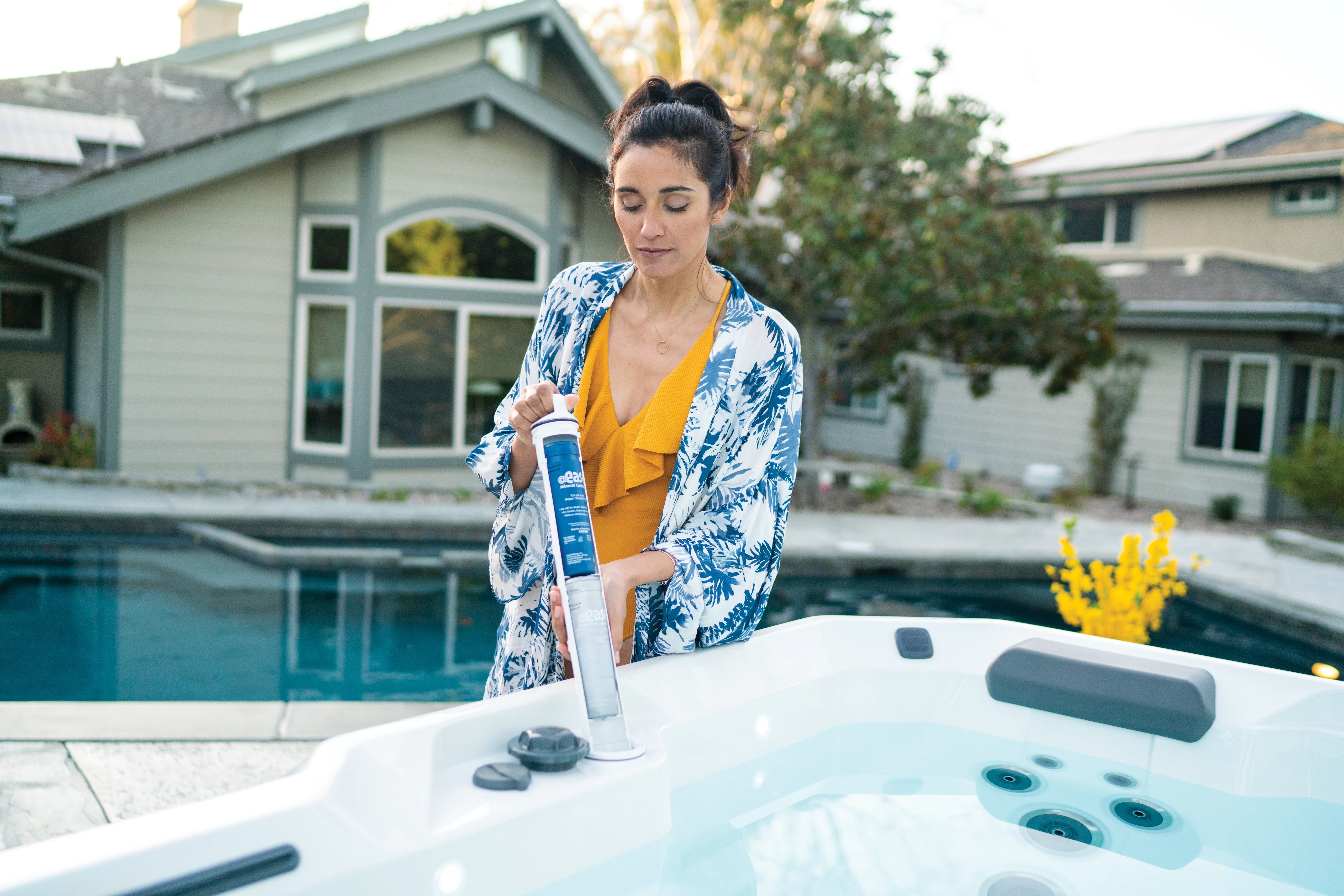
The system uses two replaceable cartridges: a mineral cartridge that lasts up to 4 months, and a sanitizer cartridge (SmartChlor or bromine) that lasts 3–4 weeks. The SmartChlor cartridge is self-regulating—it releases more chlorine when demand is higher (like after heavy use) and less when demand is low. This “set it and forget it” approach means you only need to shock once per month instead of weekly.
Key advantage: No chlorine smell, no fading swimwear, significantly less chemical handling. Compatible with ozone systems for even further reduction in sanitizer use.
Drain and refill: Every 3–4 months.
Compatible with: Spas with built-in inline systems (many Hot Spring, Caldera, and other brands). Floating versions available for most hot tubs.
FreshWater Salt System
Best for: Owners who want the simplest possible water care with the least chemical handling.
The FreshWater Salt System is a patented system available on Hot Spring, Caldera, and other Watkins Wellness brand spas. It uses a titanium cartridge to automatically generate chlorine from a small amount of salt added to the water. The system is controlled through the spa’s integrated control panel, which lets you set the desired chlorine output level and prompts you every 10 days to test and adjust.
The disposable titanium cartridge requires zero maintenance and lasts approximately 4 months. With three cartridge changes per year, the system keeps water clean for up to a full 12 months before a drain and refill is needed—compared to every 3–4 months with traditional methods. The water feels softer and more natural, with no harsh chemical odors, no itchy or dry skin, and no red eyes.
For the ultimate experience: The FreshWater IQ smart monitoring system (available on Highlife and Limelight Collection spas) automatically tests your water every hour and displays clear instructions when adjustments are needed for pH, chlorine, and salt levels. It takes the guesswork out of water care entirely.
Pair with: A FreshWater Mineral Spa Sanitizer (silver ion cartridge) for additional bacteria inhibition and even lower chlorine requirements.
Drain and refill: Up to once per year (when properly maintained).
Important: The FreshWater Salt System is NOT compatible with bromine or BaquaSpa. Do not use calcium hypochlorite or trichlor tablets with this system.
At Leisure Time Inc., the FreshWater Salt System is our most-recommended water care method for new hot tub buyers. It dramatically reduces the time, effort, and chemical handling involved in ownership. The 10-day check-in takes about 5 minutes, and you only drain the spa once a year. For Idaho families who want to enjoy their spa rather than maintain it, this system is a game-changer. Visit leisuretimeinc.com/pages/freshwater-method for our complete startup and maintenance guide.
Ozone
Best for: A secondary sanitization layer that reduces (but doesn’t eliminate) chemical use.
Ozone (O₃) is a powerful natural oxidizer that destroys bacteria, viruses, and organic contaminants on contact. An ozone generator (ozonator) is built into many mid-range and premium hot tubs. It works by injecting ozone gas into the water through the circulation system, where it continuously cleans the water as it flows.
Ozone is a supplement to your primary sanitizer, not a replacement. You’ll still need a residual sanitizer (typically a small amount of chlorine or bromine) in the water, because ozone breaks down quickly and doesn’t provide lasting protection when the circulation pump cycles off. However, ozone significantly reduces the amount of chemical sanitizer needed—and that means less odor, less skin irritation, and cleaner-feeling water.
The FreshWater Ozone System from Hot Spring combines ozone with MPS (non-chlorine oxidizer) and silver ions from an AG+ mineral stick for comprehensive water care with reduced chlorine. The mineral stick is replaced every 3–4 months.
Note: Ozone should not be used in combination with the FreshWater Salt System. Choose one or the other.
Compatible with: Hot Spring (FreshWater III Ozone), Caldera, American Whirlpool (CleanZone), and many other brands. Often combined with UV-C for maximum effectiveness.
UV-C (Ultraviolet Light)
Best for: Chemical-free supplemental sanitization that works continuously with no byproducts.
UV-C technology uses ultraviolet light—the same part of the electromagnetic spectrum that the sun naturally produces—to neutralize bacteria, viruses, algae, and other waterborne pathogens by destroying their DNA. The water passes over a UV-C bulb housed inside the circulation system, and pathogens are rendered unable to reproduce. The process adds absolutely no chemicals, no gas, and no byproducts to the water.
Sundance Spas leads the industry in UV-C technology with their CLEARRAY Active Oxygen system, which is factory-installed as standard on all acrylic Sundance models. The CLEARRAY system goes beyond basic UV-C by combining it with ozone injection: the ozonator injects a low dose of ozone into the water, and when that ozonated water passes by the UV-C bulb, it energizes active oxygen molecules through an advanced oxidation process. This combination treats 99.9% of waterborne pathogens.
American Whirlpool offers a similar approach with their CleanZone Ultra dual sanitization system, which combines ozone and UV-C light to kill 99.99% of microorganisms, bacteria, viruses, and parasites.
Like ozone, UV-C is a secondary system—you’ll still add a small amount of chlorine or bromine for residual protection. But the UV-C system handles the heavy lifting, so your chemical sanitizers have far less work to do. The UV-C bulb typically requires annual replacement.
Compatible with: Sundance Spas (CLEARRAY Active Oxygen, standard on all acrylic models), American Whirlpool (CleanZone Ultra), and available as an aftermarket add-on for many other brands.
Water Care Methods at a Glance
| Bromine | Chlorine | FROG @ease | FreshWater Salt | Ozone + UV-C | |
|---|---|---|---|---|---|
| Primary or Secondary | Primary | Primary | Primary | Primary | Secondary |
| Chemical Handling | Moderate (tablets + shock) | Moderate (granules + shock) | Low (cartridge swap) | Very Low (salt + cartridge) | Low (reduces primary chemical need) |
| Weekly Effort | 10–15 min | 10–15 min | 5–10 min | 5 min every 10 days | Depends on primary method |
| Shock Frequency | Weekly | Weekly | Monthly | As needed | Weekly (reduced amount) |
| Drain Frequency | 3–6 months | 3–4 months | 3–4 months | Up to 12 months | 3–4 months |
| Odor | Mild | Noticeable | Minimal | None/minimal | None (no byproducts) |
| Skin/Eye Comfort | Good | Fair | Very Good | Excellent | Excellent (reduces irritants) |
| Best Paired With | Ozone, UV-C | Ozone, UV-C | Ozone | Silver Ion Mineral Sanitizer | Bromine, Chlorine, or FROG |
City Water vs. Well Water: Why Your Source Matters
Where your water comes from has a significant impact on your hot tub maintenance experience. In Idaho, many homeowners are on well water—and the mineral content of well water varies dramatically depending on your location, depth, and the geology of the surrounding area. Understanding your water source is one of the most important steps in setting up and maintaining a hot tub.
City (Municipal) Water
Municipal water has already been treated and tested by your local water utility. It’s generally easier to work with in a hot tub because the heavy lifting—removing sediment, reducing bacteria, adjusting pH—has already been done. However, city water isn’t perfect:
- Chlorine/Chloramine: City water contains residual chlorine or chloramine from the treatment plant. This isn’t harmful to your spa, but it does mean your initial readings may show elevated sanitizer levels that settle over a day or two.
- Calcium Hardness: Depending on the municipal source, city water can still be quite hard (high calcium and magnesium). In parts of Idaho, city water calcium levels can exceed 200–300 ppm. This is manageable but may require attention.
- pH and Alkalinity: Municipal water tends to have relatively stable pH and alkalinity, usually close to the ideal range for hot tubs (pH 7.2–7.8, alkalinity 80–120 ppm).
Well Water
Well water is untreated groundwater drawn directly from the aquifer beneath your property. It can be excellent hot tub water—or it can present real challenges. The key variable is mineral and metal content, which depends entirely on your local geology:
- Iron: Well water in many Idaho areas contains dissolved iron. When exposed to air or sanitizing chemicals, iron oxidizes and can turn your water brown, orange, or rust-colored. It can also stain the spa shell and leave deposits in plumbing.
- Copper: Copper can come from the well water itself or from copper plumbing in your home. It causes green or black staining on spa surfaces and can build up as water evaporates and is topped off.
- Calcium and Magnesium (Hardness): Well water is often significantly harder than city water. High calcium levels cause scaling—a white, crusty buildup on spa surfaces, heater elements, jets, and plumbing. Scaling reduces heater efficiency and can damage components over time.
- pH Variability: Well water pH can range from quite acidic to quite alkaline, depending on your soil and rock composition. This makes initial balancing more unpredictable.
- Sediment: Some wells produce silty or sandy water that can clog filters quickly.
Treating Your Water: Recommendations for Idaho Owners
Regardless of your water source, we recommend these steps every time you fill or refill your hot tub:
- Use a hose-mounted pre-filter every time you fill. Products like the Clean Screen Pre-Filter attach to your garden hose and remove sediment, metals, and other impurities before they enter your spa. This is especially important for well water users.
- Bring a water sample to your local Leisure Time Inc. store before your first fill. We’ll test for metals, phosphates, calcium, and other factors that standard test strips don’t cover. This baseline test helps us recommend the right startup products for your specific water.
- Add Metal Gon and Defender at startup. These sequestering agents lock metals and minerals into solution so they can’t precipitate out, cloud the water, or stain spa surfaces. This is part of the standard startup procedure on our water care guides.
- Consider a Vanishing Act Calcium Remover or On The Go portable water softener if your calcium levels are above 200–300 ppm. The Vanishing Act is placed in your filter compartment during fill and reduces calcium hardness over 24 hours. The On The Go connects to your hose and softens water as it enters the spa.
- For the FreshWater Salt System: starting with balanced water is especially critical. High calcium, metals, or phosphates can interfere with the system’s titanium cartridge and shorten its lifespan. Take that water sample to your dealer before filling.
The FreshWater Salt System works beautifully with well water—but the startup process is more important. High calcium or metals in your fill water can affect the system’s performance and sensor accuracy. Invest the extra 15 minutes in pre-filtering, testing, and treating your fill water, and you’ll be rewarded with a full year of easy maintenance. Our FreshWater Method guide at leisuretimeinc.com/pages/freshwater-method walks you through every step.
City Water vs. Well Water: Quick Comparison
| Factor | City Water | Well Water |
|---|---|---|
| Pre-treated? | Yes – chlorine/chloramine added | No – raw groundwater |
| Calcium Hardness | Moderate (varies by region) | Often high – scale risk |
| Metals (Iron, Copper) | Usually low | Often elevated – staining risk |
| pH Stability | Relatively stable | Can be unpredictable |
| Sediment | Minimal | Possible (silt, sand) |
| Pre-filter Needed? | Recommended | Essential |
| Dealer Water Test at Startup? | Recommended | Essential |
| Metal Sequestrant Needed? | Depends on test results | Almost always yes |
| Salt System Compatible? | Yes – generally straightforward | Yes – with proper pre-treatment |
Water Care by Brand: What’s Built Into Your Spa
Different brands take different approaches to water care. Here’s what you’ll find on the brands available at Leisure Time Inc.:
Hot Spring Spas: FreshWater Salt System available on all collections (Highlife, Limelight, Hot Spot). FreshWater IQ smart monitoring on Highlife and Limelight. FreshWater Ozone System available as alternative. 100% no-bypass filtration on Highlife models with Tri-X filters.
Sundance Spas: CLEARRAY Active Oxygen system (UV-C + ozone) standard on all acrylic models. MicroClean filtration system. Compatible with chlorine or bromine as primary sanitizer. SunPurity minerals available.
American Whirlpool: CleanZone ozone system standard. CleanZone Ultra (ozone + UV-C dual sanitization) available as upgrade. Kills 99.99% of microorganisms. Compatible with chlorine or bromine.
Caldera Spas: FreshWater Salt System compatible (same Watkins Wellness platform as Hot Spring). FreshWater Ozone available. FROG @ease inline system compatible. FiberCor insulation and EnergyPro system.
Endless Pools: FreshWater Salt System compatible on fitness systems. Larger water volume (1,200–2,400 gallons) means more chemical product needed at startup and higher ongoing consumption vs. standard hot tubs.
Frequently Asked Questions
Is hot tub maintenance hard?
No. Once you establish a weekly routine, most hot tub maintenance takes 5–10 minutes per week. Advanced systems like the FreshWater Salt System reduce this even further. The key is consistency: a few minutes each week prevents problems from developing.
What’s the easiest water care system?
The FreshWater Salt System is the simplest available. It automatically generates chlorine from salt, prompts you every 10 days to check and adjust, and keeps water clean for up to a year between drain-and-refills. When paired with FreshWater IQ smart monitoring, the system even tests the water for you every hour.
Can I use well water in my hot tub?
Absolutely. Many Idaho homeowners fill their hot tubs with well water. The key is pre-filtering during fill, testing for metals and minerals at your dealer, and using appropriate sequestrants and softeners at startup. Once balanced, ongoing maintenance is essentially the same as city water.
How much do water care chemicals cost?
Typical monthly chemical costs range from $15–25 for traditional bromine/chlorine methods, and $10–20 for FreshWater Salt System owners (primarily the cost of the titanium cartridge spread over 4 months, plus occasional test strips and pH adjusters). Kits and bundles at shop.leisuretimeinc.com help simplify purchasing.
How often do I need to drain my hot tub?
With traditional water care (bromine, chlorine, FROG), plan on draining every 3–4 months. With the FreshWater Salt System, properly maintained water can last up to 12 months. When you drain, it’s a great time to flush the plumbing lines, clean the shell, and deep-clean or replace your filters.
What happens if I don’t maintain my hot tub?
Neglected water becomes cloudy, develops an unpleasant odor, and can harbor bacteria that cause skin infections or respiratory irritation. Unbalanced water also damages equipment—corroding heaters, scaling jets, and shortening the life of seals and gaskets. A few minutes of weekly maintenance protects both your health and your investment.
Water care shouldn’t be intimidating. At Leisure Time Inc., we provide complete water care guides for every sanitization method on our website, offer free water testing at all three of our Idaho locations, stock every chemical and accessory you’ll need at shop.leisuretimeinc.com, and provide ongoing support for the life of your spa. Whether you’re on city water in Boise or well water in rural Idaho, we’ll help you find the right approach for your water and your lifestyle.
Clean water. Simple routine. More time to soak.
Water Care Guides: leisuretimeinc.com/pages/water-care-guides
FreshWater Method Guide: leisuretimeinc.com/pages/freshwater-method
Bromine Method Guide: leisuretimeinc.com/pages/bromine-method
Ozone Method Guide: leisuretimeinc.com/pages/ozone-method
FROG Method Guide: leisuretimeinc.com/pages/frog-method
Shop Water Care Products: shop.leisuretimeinc.com
Hot Spring Water Care: hotspring.com/learning-center/water-care
Sundance Water Care Tips: sundancespas.com/en-us/water-care-tips
Locations: leisuretimeinc.com/pages/locations